So I just turned 55, mere days after leaving my son at college on the East Coast. Naturally, this led me to reflect on my trip East 37 years earlier, the sights, the sounds, the sensations. And as the OnceWereBachelor journey turned a new corner (OnceAgainABachelor, maybe?) this transition caused me to take stock of where I am and what it all means.
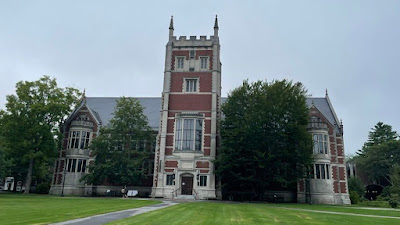
He is in the exact opposite corner if the country from me, as if he had mused "how far away can I get from mom and dad?" That's where he is, some elite liberal arts, New England school, with beautiful, remote grounds, that will very soon be exploding with bonfires of yellow and orange leaves dissolving into the Autumn sky. Until it all gives way to a World War I winter landscape of grey.
I made the same trip, to a different school that was nevertheless much the same, in 1985. For both of us, it is our first East Coast fall, and later our first bonafide winter. Like me, he will become very familiar with the scent of smoke from chimneys and Blistex on the lips, the feel of gloves, the utilitarian importance of warm footwear.
As for sounds, my freshman soundtrack was informed by the fact that immediately upon arrival, I sought out the college radio station, and obtained a Friday night slot as a DJ, spinning the latest indy music. My roommate was a mid-day jazz DJ, so we pretty much defined ourselves by that radio station. I was betrothed to REM there, the Replacements, the Hoodoo Gurus, Guadalcanal Diary, Mojo Nixon & Skid Roper. But the song that most reminds me of that freshman fall, more than the Violent Femmes' "Add It Up" or the Replacements' "Bastards of Young", is this song, "Life in a Northern Town", by the Dream Academy.
Now, the plan was to spend a few days in the area, to assemble all the gear that a Hawaii kid would need for his first extended stay in the Polar North. That meant driving to Target. Driving to Bed/Bath/Beyond. L.L. Bean (my thoughts on Bean here). While driving all over New England, I found myself listening to a band from the late Nineties and the new millenium, that I had mostly ignored until now. Fountains of Wayne were mostly an East Coast band anyway, unfortunately known for a hit song that was misrepresentative of their work.
I had recently downloaded their album Welcome Interstate Managers, generally considered their best work, and which I had come to appreciate as power pop meets singer songwriter.
Fountains of Wayne co-founders Chris Collingwood and Adam Schlesinger met back in 1986 as freshmen at another New England school, Williams College, where they bonded over learning REM songs on acoustic guitar in their dorm hallway. Thereafter, they became songwriting partners. Interstate Managers was self-financed and independently recorded in response to being dropped by their major record label. In sweet revenge, it became their most successful release thanks to the aforementioned hit song. The album is particularly resonant to me because it seems to comprise the magnificent highs, the gutter lows, and the general absurdities of Generation X adulthood that I had experienced these past 37 years. And it even contains a perfect New England winter song, just like "Life in a Northern Town" was, back when I was a freshman. I found myself hitting repeat on this song all week as we drove all over Maine, Massachusetts, and New Hampshire, a song to a New England girl I could pretend I knew. Here is "Valley Winter Song".
Another song on Interstate Managers is a crunchy uptempo number that wouldn't have been out of place on my college radio show on WRUC 89.7, which was flush with tuneful smartassery from bands like the Replacements, Mojo Nixon, or the Violent Femmes. Here is "Bright Future in Sales".
Now, Adam Schlesinger* had already carved a small niche for himself as a songwriter for movies and TV. My interest in Schlesinger was piqued because I had learned that he had penned the title song for Tom Hanks' directorial debut film, a love letter to not-the-Beatles early Sixties rock n roll.
That Thing You Do had been on repeat in my living room for the past couple months. It is a perfect film that just captures a sweet and innocent creative moment, when fame doesn't really matter, and neither does musicianship or even songcraft. What matters is friendship and love and youth. Just consider the clip above, the pure exuberant joy, the sheer Hard Day's Night of it all, friends cheering each other on. It is the film I turned to when I realized that my son was in fact going to leave me very soon, and there was no turning back. It made me feel better about what was going to happen next. Or at least help me forget it was happening.
*I hate to write this footnote, but, despite his youth and health, Adam Schlesinger died of Covid-19 very early in the pandemic, in April of 2020. Rest in Peace, Adam. Thanks for the tunes.
Johnny Ramone would most definitely have been a Trump supporter. Although he and I both were Reagan fans in the 80s, the Donald is where he and I would certainly have parted company vehemently. But for a variety of reasons, this has been a summer of Ramones for me. In fact, I had the opportunity to consider Johnny, Joey, Dee Dee, Tommy, and Marky as individuals, and ultimately I arrived at a thought that I subconsciously knew to be true. The Ramones are my all time favorite band.
SUMMER SOUNDTRACK, SUMMER READING
As longtime readers of OnceWereBachelors know, I like to choose a soundtrack for the summer. Like all summer soundtrack bands, I initially selected a few that I could blast in my pick up truck on drives to and from the beach, and which would raise my spirits when I spun them on my Hi-Fi turntable. I had chosen some good ones meeting those criteria.
But for whatever reason, independent of the soundtrack I was listening to, my summer reading started with the memoir I Slept With Joey Ramone, by Mickey Leigh, Joey's younger and much more hapless brother. Then as I neared the halfway point of that book, I acquired a copy of Punk Rock Blitzkrieg, by drummer Marky Ramone, which I would quickly turn to next. By then, the other bands had disappeared from my iTunes rotation, and a steady stream of Ramones vinyl replaced it. Most popular on my playlist was the double live album It's Alive, a document of their December 31, 1977 show at the Rainbow Theater in London, a show which Johnny himself considered their zenith performance. Personal faves Leave Home, Rocket to Russia, and Pleasant Dreams also got lots of airplay in my pick up. Finally, after finishing these two books, I read Johnny Ramone's unusual little autobiography, Commando.
Nota bene, I never felt the urge to read Dee Dee Ramone's own memoir, Poison Heart: Surviving the Ramones, because of his reputation as a notorious exaggerator, totally bereft of any serious credibility. I guess his mastery of punk rock metaphor, as the Ramones' prolific songwriter, went hand in hand with his daffy and loose relationship with the truth.
RAMONES DIVIDED
After first blasting out of the gate in 1976 and establishing the blue print for all post-Beatles modern rock, the Ramones quickly became its own Nation Divided. Joey occupied one coast, a Blue Stater in everything but name, steeped in the Sixties counterculture ethos of individuality, inclusivity, beauty, poetry, and a good time. Despite punk rock's disdain for filthy, smelly hippies, Joey for all intents and purposes, was one. On the other coast was Red Stater, Johnny, who, upon induction into the Rock n Roll Hall of Fame in 2002, famously accepted his award by saying "God Bless President George (W) Bush."* The two became opposite ends of the compass, who were so estranged that they all but ceased to communicate.
MICKEY'S TAKEDOWN
Mickey Leigh did the best he could to posthumously deflate Johnny's legend. Aside from providing much appreciated insider detail about being in the pull of the Ramones' gravity, Leigh found many opportunities to portray Johnny as a bully, greedy and venal, and willing to beat women, and utterly callous about Joey's untreated mental illness, especially his OCD. I'm sure some of it was true, even the wife-beating, but I think Leigh's portrayal was a transparent attempt at giving his bitterness a target, a bitterness that was not really about Joey's treatment, but rather a bitterness that Leigh himself did not reap the meager benefits that his brother and the other Ramones enjoyed. Leigh is responsible for much of the Johnny-directed hate within Ramones Nation.
And it was this abiding repulsion that Leigh's book left me with that made me regret the reaction I had years ago, on the morning I learned that Johnny Ramone had died at the age of 54. I cried. Unabashedly and immediately, for probably a good five minutes, I cried. A full grown man, a father, and a professional, I cried. It just hit me hard. By the day of his death on September 15, 2004, Johnny was my favorite Ramone. He was a punk rock stalwart, a stoic warrior of the ethos who gave in to no one, even in his devotion to the Reagan Revolution, a hard worker who suffered no fools, pulled no punches, and -- his often cartoonish music notwithstanding -- kept the Mickey Mouse to a bare minimum. In that way, to me, Johnny was more a guitar-wielding Mercury astronaut than a musician. By 2004, I knew that it was Johnny who kept the Ramones train rolling all those years, in spite of Dee Dee's severe drug addiction, Marky's alcoholism, and Joey's erratic mental health, all with virtually ZERO support from the radio or MTV or the industry of cool that is popular music.** Even in the inclusive and supposedly free-wheeling world of rock and roll, the Ramones were misunderstood, uncool outsiders, who survived largely thanks to Johnny's sheer strength of will. Leigh's book made me question all that.
THE VIEW FROM THE DRUMMER'S SEAT
Then I read Marky Ramone's book. Marky rode the Ramones' drum throne the longest, and although he wasn't the architect of their relentless 16th note attack (Tommy pioneered that), he laid down the beat on many of their most iconic and enduring songs. I Wanna Be Sedated. Do You Remember Rock n' Roll Radio. Rock n' Roll High School. Pet Sematery.
A word about drummers: drummers are wired to be peace makers, conflict resolvers. Guitarists and lead singers may think they are the leaders, and ostensibly they are, but drummers lead from behind. I am a drummer, and I believe this. It is our beat that moves the whole room. The explosions of our cylinders propel the music. And instinctively, we want harmony and rhythm in our band, our tribe. Which explains, first why Marky's book was the way it was, and second, why I find it to be the most believable and honest.
Drummers also know that the rest of the band think the drummer is the most replaceable of its components. True or not (mostly not), it is what keeps drummers humble. It also makes them grounded, realistic, and clear eyed. Keith Moon and Ginger Baker are exceptions, not the rule, and Marky was not like them. As evidence of this, I learn, Marky rehabilitated himself by becoming an A.A. disciple. For the band.
And so Marky's memoir restored just a little bit of luster to Johnny's persona. Per Marky, Johnny is still conservative and reactionary and jingoistic, and he is still a bully and a manhandler of "his" women. But Marky affirms that he was also driven and, while demanding, also fair and just in his treatment of all the personnel that made the Ramones machine function. Joey is still an untreated mental casualty with paralyzing OCD and awful hygiene habits, but it's clearer in Marky's book that Johnny is doing his best to deal with Joey's faults -- and Dee Dee's chronic drug abuse and kleptomania -- in order to knit the band together enough, so they could climb onstage every night, 200 nights a year for 22 years.
REQUIEM FOR HIMSELF
Before he reinvented himself as a Ramone, John Cummings was a prototypical juvenile delinquent, attended military school by his own choice, and held down a job as an ironworker for years. He, Tommy Erdelyi, Jeff Hyman, and later Douglas Colvin, came from the same Queens neighborhood. They talked themselves into forming a band (John and Tommy's second after the Tangerine Puppets), renaming themselves and developing an aesthetic in the process, and changing the face of popular music entirely by inventing punk rock.
His autobiography is the most remarkable of its type I've ever read. I can only assume it was his own decision to name it after one of the Ramones' many great, loopy chest-beater songs, Commando. It's title says a lot about what Johnny thought of himself.
In the book, Johnny confirms almost all of the accusations leveled against him in some of the most matter of fact prose this side of Hemingway. Some of my favorite quotes:
"We started 1978 on tour with the Runaways, a band of dykes"
"I wrote the book on punk. I decide what's punk. If I'm driving a Cadillac it's punk."
"In my head it was never officially over until Joey died in April 2001. There was no Ramones without Joey. He was irreplaceable, no matter what a pain he was. I wouldn't have wanted to play without him no matter how I felt about him; we were in it together. He never quit. We broke up and he died ... I thought I wouldn't care and I did, so it was weird. I guess all of a sudden, I did miss him. But he made an impact through his life, so he's still among us."
His book also reveals that he meticulously kept track of the details in his Ramones life, in a collection of cheap vinyl-covered day planners available at drug stores. These were filled with terse notes: -June 23, 1975: played for Sire (Records) - received offer. -June 7, 1976: Album: 113 on Billboard. -Dec. 31, 1977: Played London Rainbow Theater w/Rezillos, Generation X Att(endance): 2962 sold out.
This continued through the years until the end. -March 16, 1996: Played Buenos Aries att: 43,000 Eddie (Vedder) at show.
In the end, I believe Johnny was less the selfish and heartless misanthrope that Mickey and Dee Dee would have him be. He was less the false friend who stole Joey's girl. Then again, he was also less the heroic figure climbing aboard the rocket to venture into space that I thought he was when I wept for him on the day he died. He was more like the asylum orderly supervising the crazies who all harbored misperceptions of him.
If Johnny were alive today, I'm sure he would gleefully be cheering our current president on without remorse. I'd give him that, even though I gravely despise that perspective. After all, this is America, and America is where punk rock was invented.
*The Joey-Johnny dichotomy may have its origins in the fact that Johnny ultimately stole Joey's girlfriend out from under him in 1980, and eventually married her. Johnny and Linda were together until the day Johnny died. But that is of little consequence to my summer.
**Sire Records, the Ramones own label, and particularly its owner and his wife, Seymour and Linda Stein, are excused from this criticism. They always stood by the Ramones with what little power and capital they had, even from the beginning when they first encountered the Ramones' unpolished act on the dingy CBGBs stage in 1976.
By the 1930s, America's greatest architect, Frank Lloyd Wright, was in a slump. He had disappeared to his singular home and school in Milwaukee, where Taliesin Fellows came to learn design from the Master, a refined philosophy of style that was acutely sensitive to its surroundings and also rejected the European old school that dominated the 19th Century. In fact, despite being a leader in this design movement and building many structures from that century into the 1920s, Wright had stopped taking commissions, withdrawing perhaps out of burnout, but also because of a handful of personal challenges including scandal (believe it or not, a mass axe murder at Taliesin) and divorce. By that point, one wonders if Wright himself thought he was finished. He was almost 68 when in 1935 he was approached by one of his students, Edgar Kaufmann, Jr., the scion of a Pittsburgh, PA retail family, to design a summer retreat for his family near the Appalachian foothills. They had long held a large, uneven parcel of land there with a lively stream called Bear Run coursing through it. The rudimentary cabins the Kaufmanns maintained there had deteriorated and an upgrade of some kind was in order.
-- o O o --
This year, my son becomes a teenager. No longer can I baby him or touch him gently or affectionately, at home much less in public. The time has arrived for him to be treated like a man, so that, by the time he becomes one, the behaviors are already instinct. At the same time, my life reaches a mid-century. My 14 year law partnership is amicably -- but sadly -- dissolving as one partner is given a judgeship. My neglected health needs attention, and I've been getting by on decades of invincibility. I have been divorced for five years.
As a History major, I've always minded my past, treating it as an important touchstone. So, it was with great joy that I received the response to this last minute status on Facebook. "If any yinz wanna grab a cold, frosty Yuengling, I'm in Steeltown the resta da week, an'nat. "
My son plays violin at a near professional level, and his school orchestra was traveling to Pittsburgh to compete in the National Orchestra Festival.
In response to my Facebook post, my two best friends from Georgetown were going to drop everything to drive down to meet me. Also, a law school classmate from Notre Dame, whom I knew mostly through Facebook, got a pass from her husband (who knows me not at all) to drive the two hours from Ohio to meet us.
To add to my luck, I learned that same day that, as part of the trip to Pittsburgh, my son's school arranged for a guided tour of nearby Fallingwater, possibly America's most celebrated private residential home. Thinking they were mostly in Chicago and points west, I didn't even know any important Frank Lloyd Wright structures were in Pennsylvania, much less his greatest masterpiece.
-- o O o --
Kaufmann's Department store made the family who owned it reasonably wealthy. Not as wealthy as Pittsburgh's steel magnates, like the Carnegies, but close enough. When the family first showed the property to Wright, they pointed out a beloved waterfall where for years Kafmanns would play and sun and swim. They hoped their new summer retreat would have a view of it. The plans were finally revealed months later, in a classic surprise visit to Wisconsin by family patriarch Edgar Kaufmann Sr., in which Taliesin apprentices remember Wright calmly drawing the design he'd had in his head in the final two hours before his arrival. Kaufmann Sr., who had to be persuaded by his son to commission Wright, was angered to discover that the architect had decided to situate the house atop the rocky waterfall. During construction, conflict and disagreement continued when Wright subsequently learned that an independent engineering review of his cantilevered design was conducted behind his back at the behest of Kaufmann Sr. Wright threatened to walk off the project and Kaufmann Sr. relented. Apparently, to this day, legend has it that the engineering critique remains buried in a stone wall on the property. Upon completion, the final cost of Fallingwater was $ 155,000.00 in 1937 dollars. Built of Pittsburgh steel, concrete, and stone quarried on Bear Run land, the family lived and entertained there for the next thirty years. It is unquestionably a masterpiece, nearly voted the Eighth Wonder of the World (losing to Macchu Pichu), or so the joke goes. Embodying Wright's tenets of harmony with its environment, organic design, and Asian spatial aesthetics, no words can really describe a visit to Fallingwater without falling short.
-- o O o --
When we fly out of Honolulu, my ex-wife drives my son and me. We are friendly. Supportive of each other. We are family and always will be. And yet I feel alone when there's no one to kiss goodbye. It reminds me of that scene in When Harry Met Sally, where Harry sees Sally lovingly say goodbye to her lover at the airport and he observes, "You're obviously at the beginning of your relationship."
I find myself feeling that way a lot lately. Ennui. Cosmic ennui.
The perfect panacea for cosmic ennui, I hope, are the boys from Georgetown, the Jesuit and Thomas the Editor, and the person I shall call The Domer. The plan is an afternoon of cocktails and laughter in a reasonably hospitable publican's establishment, followed by an Uber ride to the PPG Paints arena for a face off between the Penguins of Pittsburgh and the Lightning of Tampa Bay.
After days of attending orchestra events with my son, his classmates, and their way-too-intense-and-invested parents, Friday comes and I finally break away to meet my friends. I'm just getting used to the feeling of my son so eagerly shooing me to walk off and leave him with his friends.
"I'm gonna head down to your lobby and mill around like Julia Roberts," the Domer messages on Facebook. She has a way of being familiar and chummy, and yet she refuses to engage in cellphone texting with me and the Georgetown boys. Too cozy. I love that. She and I were like ships passing in the night in Law School, sharing mutual drinking pals and seeing each other at every social event, yet probably never saying a single word to each other. I was in the Slow Learner's class, as Notre Dame's Prof. Charlie Rice quipped, and she, not. And yet, even then, I knew that she would be great fun to down beers and take in a hockey game with. I was not wrong.
I knew that this cocktail of people would work, otherwise I never would've stirred it in the first place. I've already painted enough of a portrait of Thomas, but the Jesuit deserves a bit more attention. As I've said before, he comes from the Eisenhower era. Unchallenged as our spiritual and moral center, around which Thomas and I whizzed and sparked around like electrons. The Jesuit was my guide through things literary and Catholic. He came from Buffalo and had a major league throwing arm. To that point in my life the Jesuit was probably the smartest person I knew.
And I was right. The Domer fit right in. Joke for joke, story for story, entendre for entendre, we entertained each other, running our fingers over the sometimes-pebbled, sometimes-polished texture of our fifty year long lives. We compared child raising notes, even Thomas, who was later to the parenting game than even I was. That night I went to a hockey game and a conversation broke out.
It was just what I needed.
-- oOo --
Over the years, people quipped that Wright and the Kaufmanns should have named the summer home Spreadingmildew. I've read that when owners of Frank Lloyd Wright homes meet each other, the first thing they ask is "how many leaks does your roof have". Walking through Fallingwater, especially as I did during the tour with my son's orchestra at the end of February, the spaces were cave-like and dank. Spectacular views out, yes. Beautiful built in furniture, yes. But cozy? Not exactly. No matter, though. Perfection needn't be perfect. It was still the most sublime space I'd ever stood in. Ample sunlight made for wonderful shadows everywhere. Generous glimpses of the nature outside from every spot inside. Rainfall shower heads in every bath, over a half-century before rainfall shower heads were even a thing. In 1968, the Kaufmanns left the property in the hands of the Western Pennsylvania Conservancy, so that accomplished middle school string musicians could experience it for posterity. In 1981, a comprehensive report was written by an expert museum auditor on what could be improved at Fallingwater. This experienced curator recognized the pricelessness of the property and its contents (all of its furniture, after all, had been designed by Wright), and recommended numerous ways to improve preservation in the midst of daily tours. The report was shared with Kaufmann Jr., then in his seventies. Kaufmann, like Wright before him and the engineer's report, rejected it outright. He commented to the WPC Director that Fallingwater was a summer retreat to his family, a place where his family sent discardable things too beloved to discard. They felt no instinct to put these things behind glass.
-- oOo --
I tried to get Thomas and the Jesuit and the Domer on the list for that afternoon's private tour of Fallingwater, but there wasn't room. The Domer would rise early the next morning after the hockey game to be home in time to find her husband embarking on yet another ambitious home improvement project. No wonder she got the pass. "Next time, mai tais in Waikiki," she said, and I'm pretty sure she meant it.
Thomas and the Jesuit were really interested in the house but they had roughly ten hours of driving between them to their respective homes in Brooklyn and Buffalo.
Our orchestra group jumped on the tour bus that had taken us around Pittsburgh all week and we set out for the foothills. We enjoyed lunch in Ohiopyle, a speck of a town that existed only to guide river rafts in the summer and feed Fallingwater tourists. On the final leg of our drive to Bear Run, the Juicy Lucy I ordered put me to sleep as I listened to Steely Dan's "My Old School" from a playlist I had created just for my reunion with those three.
-- oOo --
To gain an initial view of Fallingwater, one follows the original driveway several hundred yards downhill. The house appears dramatically from within an obscuring thicket of trees. As I was walking down this drive, I easily picked out Thomas and the Jesuit, who had decided to take an earlier tour, hoping also to catch me upon my arrival. We exchanged brief comments about the tour and the house and the drive, laughing like we always do. We hugged and I continued down the hill and they up. It was less than three minutes. Perfection need not always be perfect.
So I collect friends like
I collect shoes. I have a few special pairs I’ll wear
forever.I pledge fealty to them
and keep them going until they can’t stand it anymore.The same is true for friends. I make
them for life.Distance and time
may separate us, but I’m proud to say I have two types of friends: those I’ve
known for a lifetime, and those I will know for a lifetime.If one doesn’t fit into either of those
two categories, then I’m sorry, but he’ll be nothing more than part of the
backdrop of my life. Luckily, things like email
and Facebook are helpful in this regard.These digital tools have helped me to stay connected with my beloved
friends, and I must confess, it has also helped me expand their numbers.
Copley Hall, Georgetown University
Take for example Thomas,
whom I quickly fell in with our first year at Georgetown.Friendships formed deep in the dark
bowels of an antebellum dormitory are hard to quantify or describe, but he and
I, and a couple others, drew closely together like a tight, wet knot.In the end, we marched drunkenly side by side up
muddy hills in that final Senior Week, feeling like we’d all been in the same
platoon in Vietnam. The last time I saw Thomas
was probably 20 years ago in Buffalo.I had come from Honolulu and he from New York City, to stand next to our
other bestie while he took his marriage vows.We were there moments after Larry had his “talk” with his
Eisenhower-era dad, who offered a few terse words before the whole shebang
fired off: “Tonight’s the big
night , Son.Be gentle.” Thomas and I looked at
each other with bemusement so familiar … Anyway, right, the digital
age.So we email on a semi-annual
basis, and these messages serve as a more substantive exchange than those we
enjoy every few weeks on Facebook.Here’s a lengthy one that is, I think, emblematic of men just
like us, who have followed this path to forty-something OnceWereBachelorhood. It is mostly unexpurgated.
Three of Us at a Wedding, Plus Backdrop
TO: BEN
FROM: THOMAS
Totally random question that a) I should know about because it’s my
field or b) I should have asked you about a long time ago, but do you remember
this dude from Gtown, pretty sure his name was Ben Wallace — he was more my
friend (for a brief time and never that close) around Village B time; he also
lived in Village B with this totally wild crew who basically destroyed their
apartment and lived like animals, with broken whiskey bottles on the floor,
etc. — one of the dudes he lived with was like a [something infamous] and
general problem child but was [vaguely well connected]; the other was some
French dude who used to lie around naked in bed with this weird chick when I
was over visiting.
Anyway what I remember of Ben was that he had kind of dark ratty hair,
a decent amount of it, and he was quiet and kind of writerly/literary, or maybe
just an English major; he was from DC; and maybe that’s about it. We hung out
for a small bit and then drifted apart I guess.
Anyway, do you think/would you recognize him from this shot/bio? All
the details fit, I think, but it’s hard to gauge because he looks so “normal,”
for lack of a better word, and without the big hair it’s hard to judge:
Hope all is well with you. I’m at the tail end of
closing/shipping/putting out Sine Qua Non’s million-page September issue.
Insane. I’m handling 37 stories over 125 pages. Psycho. Kid #2 on the way,
supposedly due August 4, don’t know whether boy or girl. . . Kid #1, Funicular,
now 2.5 and he/she sings early Stone Roses singles by himself/herself,
unprompted. Good times. . .
All best//T
--
THOMAS BUTTS (a pseudonym)
Senior Editor
SINE QUA NON FASHION MAG (a pseudo-title, for perhaps
the flagship of its kind)
1 FANCY STREET
13th floor
New York, NY 10036
TO: THOMAS FROM: BEN Dude.
One day I
was driving and half-listening to NPR. I tuned into the middle of an
interview; they were talking about this ancient bottle of collectible wine that
supposedly belonged to Thomas Jefferson. Sounded interesting so I perked
up and paid attention. Turns out they were interviewing the author of a
book focusing on that particular bottle. THE BILLIONAIRE’S VINEGAR.
I made a mental note to get it used on Amazon because the curious subject
sounded engrossing in an esoteric but entertaining way, and because the author
sounded engaging and intelligent. At the end of the interview, they ID’d
the author as Ben Wallace.
A chill
went up and down my neck, because I remembered the following:
Many years
ago, you had a brief man-crush on a fellow named Ben Wallace, or at least
that’s what Larry and I thought. Maybe Don, too, but as with everything
Don, that’s hazy. You would come home and tell us about this guy who was
intelligent and engaging and living what I subsequently learned was what could
be described as a BRIGHT LIGHTS, BIG CITY lifestyle. Much alcohol,
debauchery, and hateful characters whom one would years later regret being
associated with. One of them, I knew through my friend, Laura, as a John Belushi-type.
Anyway, this Ben, like you, was nurturing some nascent literary
tendencies. I think I remember meeting him somewhere, probably that
bookstore/bar/coffeeshop that was enjoying some of-the-moment cachet.
Dylan’s I think it was called. You both smoked Camel Uns, I think.
Possibly weeks later, Larry came home saying that Ben had begun
researching a book he wanted to write about vampires and was turning up at
Lauinger Library with all kinds of requests.
Your
man-crush, as with many of your misadventures of the time, inexplicably faded,
never to be acted upon.
So I found
the book and paid $ 0.99 plus $3.99 shipping on Amazon Used*, eventually turned
my full attention to it, and concluded that I was right, the author was
engaging and intelligent and had written an engrossing, esoteric piece. It was a great read. And that he in fact was the fellow you had a man-crush on, many years ago.
I never
highlighted this discovery with you because I figured that you, being a New
York man of letters of sorts, would already know. Guess I was wrong.
[Take
care].
*Incidentally,
I just picked up GOJIRO used for a similar bargain basement price, after being
swept up in the giant lizard craze of summer 2014, remembering that in your
first year at some publishing house, you had shared an excerpt with me. I
can’t be bothered to read it, but it’s nice to have on my shelf, a remembrance
of 1990.
I also
just finished EMINENT HIPSTERS by Mr. Donald Fagen, a loose collection of his
writing. Again, the low low price being the common feature of this
footnote. He sounds like an asshole. Be careful not to meet your
heroes.
TO: BEN FROM: THOMAS The whole thing is kind of nuts — I’ve seen his byline (off and on ... he’s been getting some
good play lately at New York mag) for years now but never had the a-HA! moment
until yesterday. (In fairness, it’s a somewhat generic name for a NYC writer,
and there’s another more famous one named Ben Wallace-Wells throwing me off the
scent.)
Your recollections are quite exact — more detailed than mine. I’ll cop
to the man-crush and the literary vibe, and a big yes on the roommates, and the
strange abandonment of friendship. (For no particular reason; I think we
enjoyed each other’s company fair enough but we never really found like THAT
THING that we were both obsessed with, or bonded over, or some such. And/or we
weren’t secure enough in our literary man-crushes to be all “Hey — do you love
William Blake and want to pattern your life on his work? Me too!") Don’t
remember the meeting at Dylan’s (though I do remember the
hot-spot-of-the-moment vibe of that place). I think I’ll look him up — though
my initial note to him is bound to be quite awkward (“Remember some weird dude
from Village A that you hung around with for like 5 minutes in 1987 and then
never really saw again? Well it’s me!"
Anyways. . . GOJIRO! Yes. I remember everything about that book being
kind of cool, though even I never read the damn thing. Have since become
friendly with the writer, who’s a very cool cat.
And Fagen’s book: It’s been on my maybe-I-buy-this-next list for a
while now; frankly the only thing holding me back is what I have heard or read
from reviews about the whole bummer/bitter vibe of the whole thing. Or maybe
it’s just part of the whole thing. Though I think I do understand his
frustration (I think I read some excerpt about his opinions of the crowds at
his recent shows, and having seen he and Becker a couple years back at the
Beacon Theater here, I second that emotion — I didn’t think the crowd would be
filled with eminent hipsters per se, but I also didn’t think it would be filled
with beefy men from Long Island in suits from 1982 with their wives dolled up
like they’re seeing Frank Sinatra at the Sands in 1963.
That said, F@CK IT!!! If I judged bands solely based on the attire,
demeanor and hipness (with minus points for the dark side of the hip coin,
douchebaggery), I would have precious few bands to listen to. I’ve already
doubled down over the weekend and downloaded lossless audio files of the entire
Steely Dan discography, the better to nerd out on their particular genius of
artistry, virtuosity, and production. Long live the Dan — though I may skip
that book.
There’s been a general lack of one of those Unified Theory posts of late. Fancy cars, movie reviews, and the occasional witty bon mot do not a good read make. I suppose this can be attributed to nothing in particular. Or it can be blamed on one specific thing.
On December 18, 2006, I had been married for four years and my son was not quite three years old. We had just taken on a new mortgage and my law firm was just getting its legs. Possibilities stretched out before me, my bachelorhood a distant and uninteresting past. Then the world came crashing down. Tower Records closed its doors worldwide, including the three locations in my town.
This doesn’t have to be an Eighties Nostalgia blog in order to highlight the importance of Tower Records. Tower was born in the Seventies. It grew through the Eighties and Nineties, during which time it saw the transition from record albums to CDs, Beta and VHS tapes to DVDs. When I first started going to the Tower on Keeaumoku Street (pictured above), disco was still a living, breathing, pulsating beast. Aside from Cheap Trick, Devo, and Cars records, I was only ever interested in the hundred or so albums in the “import” bin. Adult contemporary was a vast expanse that I never explored. At the dawn of the MTV era, “imports” disappeared as a category and the more obscure artists that interested me (which included the Ramones, the Sex Pistols, the Police) found their way into the general population. There was a time that the only place one could find a copy of the Clash’s Sandinista was at a genuine communist bookstore near the University. When it appeared in Tower’s stacks, I knew a new era of pop music had arrived. In the new millennium, there was little evidence that we were seeing Tower’s final years.
No matter where I lived, D.C., London, even northern Indiana, the location of the nearest Tower Records was one of the first navigation points I committed to memory. It was that important.
In 2006, Tower was unceremoniously shelved, its stock unloaded at ever-plummetting discounts. There were many items I acquired cheaply during these final weeks of liquidation before that December 18. Things I wouldn’t otherwise have bought at retail prices. AC/DC. Pink Floyd. Jack Johnson. But there were things I failed to secure only because I was waiting for prices to drop further before the axe fell, but they never fell far enough. I had my eye on them, though. The Heavy Metal movie soundtrack. The updated Criterion Collection boxset of Kurosawa’s Seven Samurai (I had already owned the previous edition and wouldn’t justify the repeat expense without deep discounting).
This last ditch flurry of spending at Tower was mostly afterthought, and really, for me an unfitting farewell to an establishment that I used to wander through, often for as long as time would allow. Hours? Maybe. The better part of one for sure. Stack after stack after stack? Definitely. I used to love the unscheduled stop into Tower, when I had nowhere else to be. Maybe I had an inkling that a new CD had been released and I wanted to find it and snap it up quickly, so I could immerse myself in the new music, headphones on and liner notes open. Maybe I had absolutely nothing in mind and I would just let my thumb and forefinger do the searching. That’s how I discovered the Violent Femmes back in 1984, and Pearl Jam in 1991.
The protagonist in one of the books in my canon, High Fidelity, by Nick Hornby – a man as adept at observing the immature male of the species as Britain has ever produced – finds comfort in organizing his record collection not alphabetically but autobiographically ("How did I get from Fleetwood Mac's Rumours to Howlin' Wolf in just seven moves?"). Similarly, I tell you, for example, that I bought Husker Du's Warehouse: Songs and Stories in the Tower in D.C.'s Foggy Bottom neighborhood amidst a lengthy bout of angst.
I find that my acquisition of music is slowing down and more focused. I think in general, once far away from bachelorhood, musical tastes have cemented, and that is probably the biggest cause of this narrowing. But also, when the journey of discovery is no longer tactile, across the stacks at a record store, and more often on a website like Amazon or at a brick and mortar like Best Buy (which is unabashedly set up for the Transaction, and staffed with generalists), something is lost.
The further away I get from December 18, 2006, part of the enjoyment of music is lost. The act of discovery part. Which is a damn shame because then the sharing of music part eventually also diminishes. I used to play music for my wife all the time and once, she had a friend steal my truck so she could have a new stereo installed as a Christmas gift because (a) she knew how important music was to me and (b) my old stereo was really only a radio.
I can’t share music that I’ve already shared, otherwise it becomes a crusade. That would be like a Jehovah’s Witness coming back to knock on the same door twice.
Reflecting on this I realize that, as much as I love my wife and as much as she completely dwells in my heart, I don’t believe I’ve ever made her a mix tape. High Fidelity very nearly fetishizes the mix tape. The mix tape is a proclamation. It is a love letter. It is a seduction. It is an entendre. I’ve been known to make mix tapes in my time, and they’ve always had meaning (it’s like that conversation between Jackson and Travolta in Pulp Fiction: “I’ve given lots of foot massages and every one of them meant something”).
Now, without Tower Records, I’m not sure if I can really make that mix tape for my wife with the meaning it should have.

 I made the same trip, to a different school that was nevertheless much the same, in 1985. For both of us, it is our first East Coast fall, and later our first bonafide winter. Like me, he will become very familiar with the scent of smoke from chimneys and Blistex on the lips, the feel of gloves, the utilitarian importance of warm footwear.


