Showing posts with label Style. Show all posts
Tuesday, October 27, 2015
An American Look Back
She & Him is the pop music duo of Zoey Deschanel (the uncertain rebel hippie of Cameron Crowe's Almost Famous) and guitarist/producer M. Ward (sorry, I got nothing on this guy; the world is full of unsung guitar talent). Their aesthetic is decidedly retro-lux, and their presentation is reminiscent of my favourites the Style Council. I discovered this video one night while obsessively searching for vintage stereophonic console cabinets.
I was instantly captivated and charmed. I had to know more. I had to hear more. Thanks to the aforementioned obsessiveness, I quickly pieced together that their video was almost a direct cribbing of a Chevrolet film short from 1958 celebrating American Design. Wow.
Monday, August 3, 2015
Vinyl Adventures Redux
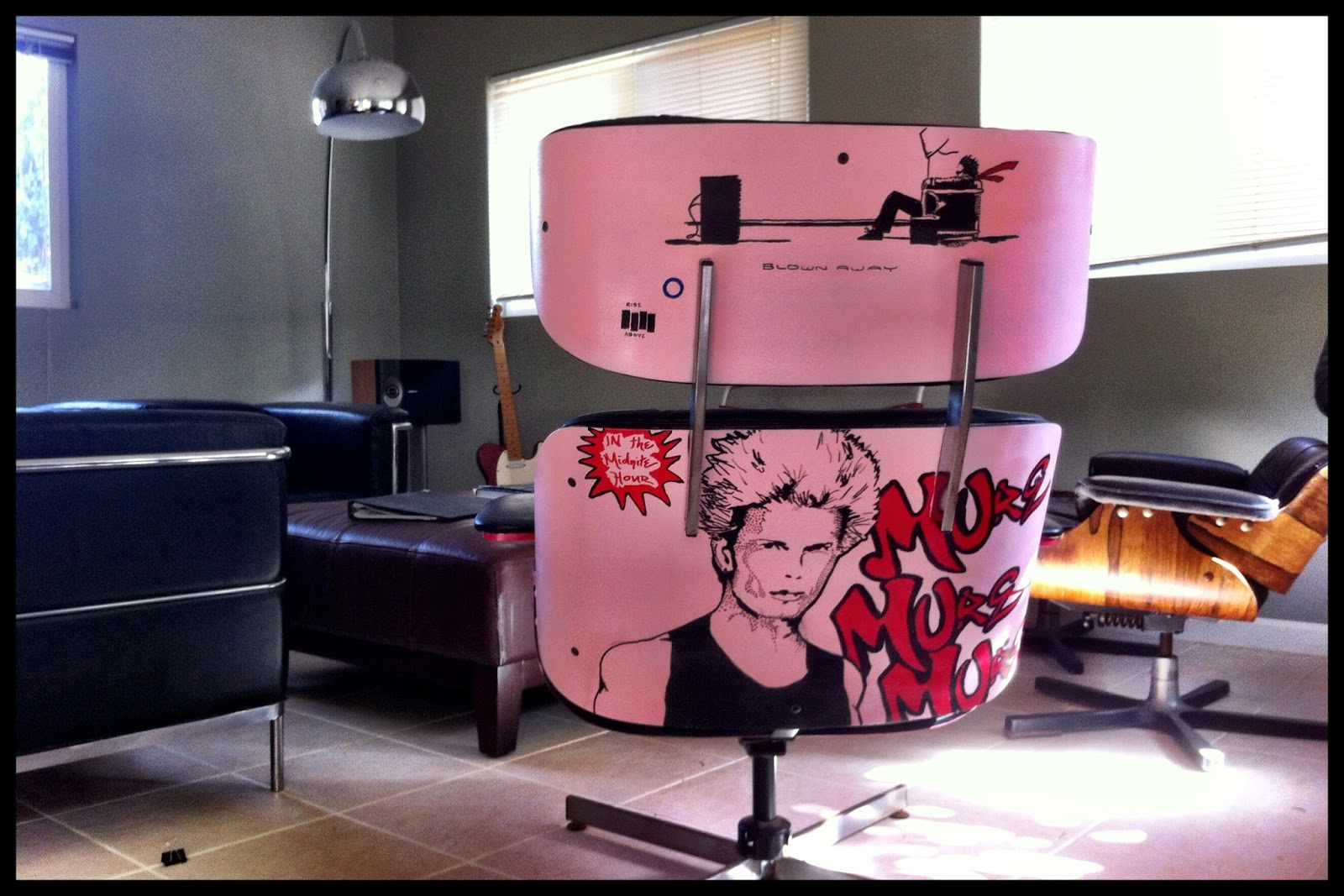
The hit parade of vinyl continues, and consequently a Mood Room is developing. I enjoyed the first couple of weeks of vinyl as played through my Eighties era Sony, when I suddenly got the hankering for analog knobs and buttons and the blue glow of Non Specific Warning Lights. As luck would have it, a 1978 vintage Sansui G-6700 showed up on Craigslist and in two shakes of a lambs tail, said knobs, buttons, and NSWLs were mine. It now serves as a 100 watt per channel traffic cop for all the audio signals my growing 70s and 80s record collection can produce.
Finding the Sansui was fortuitous for another reason. As I was driving home from the purchase through an unfamiliar neighborhood, what should I spy but the often-replicated (often poorly) Eames lounge chair, waiting to be picked up by the bulky item sanitation crew, in a condition that can best be described as Not Quite Ready for the Dump. It's sumptuous naugahyde was only a little sunbaked and cracked. Shook that lambs tail again, a screech of the brakes, and it was in the back of my truck. Only made the neighbors a little nervous.
Now, I know this particular chair was nowhere near an original example of the mid-century masterpiece by Charles and Ray Eames, manufactured by the Herman Miller Co., and extant in the dens of Mike Brady, Don Draper, Tom Corbett and his son Eddie, and Maj. Anthony Nelson and his Jeannie in a bottle. It's armrests and base were all wrong, and the quality of the materials was barely residential grade. In fact, I already have another one, also a copy, of much better accuracy, which I keep as a placeholder for when I have a spare five grand laying around for a real one. So I could've taken a pass on this one. But in an instant an alternative vision developed in my mind for this dumpster find.
Sometimes, with good fortune comes the blessing of freedom; the departure of limitation that zero overhead affords. This vision fit in perfectly with my idea of the Mood Room, where I was already doing my most profound thinking, whilst listening to vintage New Wave. The iconic lines and proportions of the Eames chair would serve as a framework for something edgy, and "out there" at least for the Reagan Era. Something graffitied and hot pink, maybe, and that goes well with the post-apocalyptic simulacra of Billy Idol music in its very prime. Something that the Warriors wouldn't be afraid to hide behind during their odyssey across New York's deadly five boroughs, while fleeing the Baseball Furies. Something that Lord Humongous of the Wasteland could use as a campaign chair while laying siege to Mad Max and his friends. You get where I'm going? Something that rocked.
So I resurrected some long dormant graphic design skills. Wielded them poorly. Took my time. Two weeks later, I have this, the listening throne to go with my crown jewel Sansui.
Reduce. Reuse. REBEL YELL!
Labels:
Bachelor Pad,
Eighties,
Hi-Fidelity,
Home Improvement,
Style,
Vinyl
Thursday, May 7, 2015
On My Wall: Shy Luchmand's Harley Girl
In 1990, George H.W. Bush was drawing a line in the sand, Twin Peaks was preparing to jump the shark in its second season, and culture was still very much locked in the Eighties. I had landed in London for my second year of law school, where me and me mates had managed to rent the top two floors of a Clapham row house belonging to an elderly Irish couple who always made it available to Notre Dame students abroad. One look at the price of burritos in the Taco Bell on Piccadilly and I knew I needed to watch my pounds sterling, at least enough to keep my local willingly pouring pints of Guinness for me between classes.
Of course, this frugality didn't last long, and soon enough I was spending as frivolously as ever. A poster of a Harley Girl was probably one of the first luxuries I treated myself to. I found her at the Camden Lock flea market one sunday, so I must've still been trying to pinch my pence a bit. Nevermind who Shy Luchmand is; apparently he's some photographer, somewhere south of Man Ray, and West of Nagel. I liked her because, like the Eighties, she radiated style, rebellion, and edge. Flannel and combat boots was still a good couple of years away. Leather, chrome, and shades, and studiously tousled locks of blonde were still not ironic.
When I left London, I left her on my wall in Clapham along with an empty bottle of Beaujolais covered with a year's accumulation of candle wax. If I could find an actual poster sized image of her, instead of this blown up thumbnail, I'd pay the equivalent worth today of what I paid then, on the cobblestones of Camden.
If this is your image, you must be Shy Luchmand. Please let me continue to use it. However, if you disapprove, feel free to let me know and I will take it down.
Tuesday, October 8, 2013
Magnus Walker: Early Porsche Aficionado and Life Architect
So everyone, especially the male of the species (which means bachelors and OnceWereBachelors), has a vision for their life formed early on, before the restraints of reason and common sense take hold. If you were to ask boys what their ideal life would look like, I bet we can all speculate accurately about what answers we'd get.
"I want to grow up to be a man of adventure, who travels the world, fights evil, makes lots of money, has a jet plane. And my mom makes me brownies and my favorite spaghetti and meatballs everyday."
"I want to be a scientist who has his own lab and invents things that help the world."
"I want to live on an island with my friends and hunt and fish for food and surf and swim all day."
Whatever that vision is, it involves an element of freedom and desire to be left alone by others - perhaps grown ups - to write one's own script, to be an architect of one's life. No one envisions a life with a mortgage, private school tuition, and high overhead.
I wonder if, when Magnus Walker was a young kid he said "I want to live in a large warehouse with tastefully wild furniture, and a tattooed bombshell for a wife. I want to make that warehouse available to Hollywood to use in edgy movies and music videos. And I want to take the fabulous amount of money I make doing that, and spend it on restoring or modifying dozens of early Porsche 911s. And I want to not have to bathe or observe norms of male hygiene too much."
If so, his dream came true. If you have an odd half hour of free time, and you like old cars and interesting living spaces, watch this.
"I want to grow up to be a man of adventure, who travels the world, fights evil, makes lots of money, has a jet plane. And my mom makes me brownies and my favorite spaghetti and meatballs everyday."
"I want to be a scientist who has his own lab and invents things that help the world."
"I want to live on an island with my friends and hunt and fish for food and surf and swim all day."
Whatever that vision is, it involves an element of freedom and desire to be left alone by others - perhaps grown ups - to write one's own script, to be an architect of one's life. No one envisions a life with a mortgage, private school tuition, and high overhead.
I wonder if, when Magnus Walker was a young kid he said "I want to live in a large warehouse with tastefully wild furniture, and a tattooed bombshell for a wife. I want to make that warehouse available to Hollywood to use in edgy movies and music videos. And I want to take the fabulous amount of money I make doing that, and spend it on restoring or modifying dozens of early Porsche 911s. And I want to not have to bathe or observe norms of male hygiene too much."
If so, his dream came true. If you have an odd half hour of free time, and you like old cars and interesting living spaces, watch this.
Tuesday, April 23, 2013
What I Wore Twenty Five Years Ago: What Paul Weller Wore
Twenty five years ago, I was fully beneath the sway of the Style Council, a pseudo-collective of self proclaimed modernists led by one Paul Weller. Like him, you can bet that I was frequently shod in the versatile black beefroll loafer. I wore them with shorts. I wore them with jeans. I wore them with pegged chinos. Mostly without socks. Utterly without irony I once wore them with my first purchased tuxedo, a shawl collar from Jos. Banks. I refused to shell out for the useless patent tux slippers to go with them, and couldn't afford them anyway.
Weller started with the Jam during the first wave of punk in the late 70s. Here he is at the close of the Jam era, dressed much like I was in a button down oxford, chinos with surcingle belt, white sox, and the aforementioned black loafers. At least I'm about 95% certain that's what he's got on his feet, as anything below his Rickenbacker is obscured by the crowd.
I was too disconnected to be a Jam fan contemporaneously, but when Weller disbanded them for a new, more mature, jazzier and more soulful project, I was on board from the get go. My trajectory as college punk morphing into urbane intellectual followed his. Known as The Cappucino Kid, Weller and the rest of his councilors cultivated an air of cafe culturalism steeped in Godardist politics and style, and seasoned their records with britpop versions of soul, vocal jazz, piano jazz (Weller's collaborator at the time, Mick Talbot, was a huge piece of the puzzle), and eighties era rap. Without a doubt the Style Council writ a blueprint followed later by groups such as Oasis and Vampire Weekend. Now, Weller knew that I knew that he knew he was posing, but nevermind that now. Here they are, dressed well and bringing it all together in style.
As you can see, towards the end of the video, what is Mr. Weller shuffling around in rather stylishly but a pair of beefroll loafers, probably in black to match the checks.
Anyway, in short order Weller closed up shop on the Style Council and moved on to his third act, the solo career. He has turned out a truly monumental catalog of solo work of depth and quality, more focused than his Jam or Style Council years. His voice too has matured and the anger of the 70s, and the flash living of the 80s, have caught up to him and thus imparting, what - more gravitas? We should all mature as well. Perhaps it's the black beefroll loafers he no doubt - here - pairs with his take on the 70s slim look.
Weller started with the Jam during the first wave of punk in the late 70s. Here he is at the close of the Jam era, dressed much like I was in a button down oxford, chinos with surcingle belt, white sox, and the aforementioned black loafers. At least I'm about 95% certain that's what he's got on his feet, as anything below his Rickenbacker is obscured by the crowd.
I was too disconnected to be a Jam fan contemporaneously, but when Weller disbanded them for a new, more mature, jazzier and more soulful project, I was on board from the get go. My trajectory as college punk morphing into urbane intellectual followed his. Known as The Cappucino Kid, Weller and the rest of his councilors cultivated an air of cafe culturalism steeped in Godardist politics and style, and seasoned their records with britpop versions of soul, vocal jazz, piano jazz (Weller's collaborator at the time, Mick Talbot, was a huge piece of the puzzle), and eighties era rap. Without a doubt the Style Council writ a blueprint followed later by groups such as Oasis and Vampire Weekend. Now, Weller knew that I knew that he knew he was posing, but nevermind that now. Here they are, dressed well and bringing it all together in style.
As you can see, towards the end of the video, what is Mr. Weller shuffling around in rather stylishly but a pair of beefroll loafers, probably in black to match the checks.
Anyway, in short order Weller closed up shop on the Style Council and moved on to his third act, the solo career. He has turned out a truly monumental catalog of solo work of depth and quality, more focused than his Jam or Style Council years. His voice too has matured and the anger of the 70s, and the flash living of the 80s, have caught up to him and thus imparting, what - more gravitas? We should all mature as well. Perhaps it's the black beefroll loafers he no doubt - here - pairs with his take on the 70s slim look.
Friday, February 10, 2012
Woody Allen's Manhattan
Paragraph 1: George Gershwin's iconic Rhapsody in Blue plays over pristine black and white images of classic New York tableau ... (nah, too declarative. And "iconic" and "classic" in the same line? Bleah.).
Let's see ... Paragraph 1: If you could only choose one movie opening to say everything there is to say about a city and person who lived in it ... (mmm. Who am I, Bill Moyers?)
Uh. Paragraph 1: Woody Allen, in his day, was New York City's biggest fan and greatest ambassador. In his love letter to Gotham, Manhattan, he can be found making some bold, and pitch-perfect artistic choices, even within the first three minutes. (Oooh, I love this ...). Truly one of the great opening scenes in the history of cinema, we start with the New York Philharmonic playing Gershwin's Rhapsody in Blue. Need anything more be said about that piece? The voice over, often considered a sign of laziness in a screenwriter, here isn't really a voice over at all. It's just Isaac Davis struggling to come up with a paragraph to open his oft-promised, never-started novel. Black and white, was there ever a more flattering way to depict images seriously? (Wait, where the hell am I even going with this? Maybe I should try Queens).
I just learned that my favorite Woody Allen film, Manhattan, is being released on Blu-Ray. I am looking forward to sharper blacks, crisper whites, clearer jazz, and the same sharp crit of pseudo-intellectual bourgeoisie and urban male neuroses that I was so captivated by when I first watched it amongst other film geeks in college. But most of all, I am looking forward to this in high-definition:
Isaac Davis's darkened apartment, he descending a spiral staircase, and his 17 year old girlfriend, played by a sublime Mariel Hemingway, seated far to the left, thumbing through an oversized book. Both are bathed in the only light sources, reading lamps, in the room. Man I love that image, a portrait of a man wandering through his things, struggling to find his way through mid-life, destination known.
Now more than ever, I feel like I live in that darkened room.
Labels:
Bachelor Pad,
Greatest Movie Opening Sequences,
jazz,
Movies,
Style
Tuesday, September 20, 2011
"The Interceptors" - Great 70s British Detective Series That Never Existed
I know next to nothing about the Jensen Interceptor that fictitiously inspired this ersatz UK actioner, starring BBC Top Gear's 3 game presenters. But I do know it was styled by Italians and "looked the business" as the Brits liked to say. That it drove like a couch is beside the point.

Monday, October 11, 2010
"Go, Mordechai!"
Something immediately struck me about this advertisement when it came on in the middle of my Hawaii Five-O. What may have resonated was that it features one of those fantasy Jetsons' domiciles that I love so much. The mid-century modern furniture wired with automation. In fact the title of this beer commercial is "Apartomatic". The clunky toggle-switched control box commanding the Rube Goldberg contraptions that finish off with the self-pouring beer tap are all exactly what I'd want in my place. As are the concealed fish tanks and cathode ray tube TV monitors. So retro cool. So neato.
But that wasn't really it. I couldn't yet put my finger on what it was that struck a chord with me about the commercial. I searched for it so I could post it here as some sort of Bachelor Pad Redux. Instead, I discovered that the commercial was directed by Wes Anderson, and it all made sense. You know Anderson, the auteur responsible for one of my favorite movies, Rushmore, as well as The Life Aquatic With Steve Zissou and The Fantastic Mr. Fox.
What really charmed me about the Stella commercial then, was what charmed me about Anderson's best-conceived and best-received film, The Royal Tennenbaums. It is on display here in one of the Great Movie Opening Sequences, Anderson's ability to craft a complete and engrossing universe, top to bottom, soup to nuts, word and song.
But that wasn't really it. I couldn't yet put my finger on what it was that struck a chord with me about the commercial. I searched for it so I could post it here as some sort of Bachelor Pad Redux. Instead, I discovered that the commercial was directed by Wes Anderson, and it all made sense. You know Anderson, the auteur responsible for one of my favorite movies, Rushmore, as well as The Life Aquatic With Steve Zissou and The Fantastic Mr. Fox.
What really charmed me about the Stella commercial then, was what charmed me about Anderson's best-conceived and best-received film, The Royal Tennenbaums. It is on display here in one of the Great Movie Opening Sequences, Anderson's ability to craft a complete and engrossing universe, top to bottom, soup to nuts, word and song.
Labels:
Bachelor Pad,
Beer,
Greatest Movie Opening Sequences,
Style
Tuesday, July 27, 2010
Mid-Sixties Europe
I had promised to revisit my parents old pictures from Europe and here they are. Paris and Amsterdam, obviously. In 1965, Dad trained on jumbo jets with KLM and Mom visited at the tail end of his stay there. They did the Continent before returning home. Dad tells me that the red Karmann Ghia he owned while there was sold, and the guilders they got from its sale were repatriated home to pay for the house they were building in Manila.
Although my Dad's favorite European vacation is to Spain, which they still do annually, he has many fond memories of the Dutch. He admired their efficiency. He liked the cleanliness and the quiet way they worshipped in the Protestant churches. And I think he liked the way they dressed. Dad was on extended stay for the airline and by the time Mom got there, he was thoroughly Europeanized. Dig the pegged trousers, Florsheims, and Renaud sunglasses. This is how they dressed for a drive in the country in Europe at the time. So much for plus ca change. The more things change, the more things change, no?
Here they are in Paris. Notice how, like everyone else there to bask in the shade of the Eiffel Tower they are dressed for tourism of a different kind than we today are accustomed to. Mom must've gone to the hairdresser every day on that trip.


I'm not going to rant about how the modern style of travel is atrocious, because it's such an uncontroversial truism that to argue the point is banal. I will also not sound a call for a return to this style of travel, simply because I wouldn't want to be walking around in a jacket and tie on vacation. Instead I invite you to appreciate a different time, a different place, and accept my representation that, at one time, before OnceWereBachelorhood had mostly buried the elan and sprezzatura of my Mom and Dad, they indulged some stylish days.
Although my Dad's favorite European vacation is to Spain, which they still do annually, he has many fond memories of the Dutch. He admired their efficiency. He liked the cleanliness and the quiet way they worshipped in the Protestant churches. And I think he liked the way they dressed. Dad was on extended stay for the airline and by the time Mom got there, he was thoroughly Europeanized. Dig the pegged trousers, Florsheims, and Renaud sunglasses. This is how they dressed for a drive in the country in Europe at the time. So much for plus ca change. The more things change, the more things change, no?
I'm not going to rant about how the modern style of travel is atrocious, because it's such an uncontroversial truism that to argue the point is banal. I will also not sound a call for a return to this style of travel, simply because I wouldn't want to be walking around in a jacket and tie on vacation. Instead I invite you to appreciate a different time, a different place, and accept my representation that, at one time, before OnceWereBachelorhood had mostly buried the elan and sprezzatura of my Mom and Dad, they indulged some stylish days.
Sunday, February 28, 2010
Yeah. I wish. The Playboy Townhouse.
I've been looking at alternatives to the suburban home of late. I wonder if I could swing something like this on a lawyer's booty. Some of us perhaps, but not me. I'm neither dishonest nor excessively lucky. Just a regular, skilled combatant.
Anyway, I know I've posted a bit about this before, but I just realized I had the whole article from Playboy's stylish (i.e. non-gold chain, exposed hairy chest) era. And it bears sharing in full. If I look closely I see my favorite Eames chair, some tulips and Saarinens (a paltry $165), and all the right proportions. Of course , as the author says, a "high-performance gran turismo" in the garage. I've googled "Playboy's Penthouse" (an article from the aforementioned non-tacky era, not a crossover with the magazine's skeevier competitor), "The Playboy Bed" (a sidebar about Hef's rotating bed with built in bar), and other similar artifacts. The Playboy Townhouse was the only one I could find in full, and, luckily for us, it is the best.
Anyway, enjoy.


Anyway, I know I've posted a bit about this before, but I just realized I had the whole article from Playboy's stylish (i.e. non-gold chain, exposed hairy chest) era. And it bears sharing in full. If I look closely I see my favorite Eames chair, some tulips and Saarinens (a paltry $165), and all the right proportions. Of course , as the author says, a "high-performance gran turismo" in the garage. I've googled "Playboy's Penthouse" (an article from the aforementioned non-tacky era, not a crossover with the magazine's skeevier competitor), "The Playboy Bed" (a sidebar about Hef's rotating bed with built in bar), and other similar artifacts. The Playboy Townhouse was the only one I could find in full, and, luckily for us, it is the best.
Anyway, enjoy.


Saturday, February 13, 2010
Monday, July 20, 2009
Good Sh*t from Hawaii: Bathys Watch Co. 100Fathoms Automatic
I've lived most of my life in Hawaii and, yes it's paradise. I wouldn't live anywhere else, but really, its greatest claims to fame are Don Ho (R.I.P.) and Hawaii Five-O. Hardly illustrious by the standards of polite society but if so moved, I can give polite society such a philodemic bitch-slapping on the merits of both Uncle Don (Tiny Bubbles. 'Nuff said) and H5O (Jack Lord's sharkskin suit, to begin with) it would be ugly. Honestly though, as much as everyone would love to visit the Islands, not everyone truly appreciates all the different amazing things they have to offer.
And so I hereby inaugurate Good Sh*t From Hawaii, beginning with the Little Watch Company That Could, which, as it turns out, comes straight outta Kauai. Bathys is run, almost single-handedly by John Patterson. John, as far as I can tell is nothing if not a fine time manager (no pun intended), who balances scientific endeavors (i.e. his day job) with horological entrepreneurialism, a love of Hawaiian watersports, and an appreciation of vintage automobiles (old Volvos, SLs, and Willys jeeps).
Bathys hit the watch scene only a few years ago as the only watch company from Hawaii to offer Swiss made precision timepieces. The term Swiss Made is jealously protected by, well, the Swiss, to ensure quality and superlative workmanship, so you know you can count on a Bathys. I have one of the original 100 Fathom automatics, actually a 2nd generation Bathys, in stainless steel with a black dial. I bought it on the strength of the Bathys reputation, which grew thanks to the internet, and because of this very evocative photograph (taken from the Bathys Website):
This image, depicting the arm of an eco-adventurer pal of John, spoke to me. It told me the watch was just a bit different but still tasteful, and I just had to have it. As you can see, this watch sits proud of the wrist, a 41mm beautifully brushed silver stainless steel case on a waterproof leather band with contrast stitching, big green numbers and a blood-red sweep second hand. It boasts a slightly curved sapphire crystal that distorts at flat angles (love it or hate it, the former for me) and thunks reassuringly when you tap it with your fingernail. It also has a beautiful chapter ring indexed both in 60 seconds and 24 hours, also in confident red, black, and white. Lastly, the face is marked with one of my favorite words: "Hawaii", and on the case back John has engraved and labeled the main Hawaiian Islands. Here's mine, serial # 6155, on my lanai railing wearing the original leather strap with deployant buckle (enlarge the image, seriously, get a load of the face!):
And here it is, at a waterfall on Kauai, wearing an aftermarket solid-link stainless steel bracelet. John will be coming out with his own bracelet with fitted lugs soon:
And finally, here we are diving on a pod of spinner dolphins on the island of Lanai and sporting a nylon NATO strap:
Because of the absence of a timing bezel, it can't really claim to be a complete dive watch. However, with a 200 meter depth rating, a spirited argument to the contrary can be made. What the watch is, in fact, is a consumate watersports watch that can be surfed, paddled, swum, or worn diving, as I have done many times, without issue. In that way, it is as Hawaiian as can be. Unlike a pure diver, however, it is stylish enough to be worn to court in a suit, as I have done probably weekly. In that way, it is as OnceWereBachelorean as can be.
In a short span, Kauai resident John Patterson, a man after my own soul (and therefore yours too) has taken his little watch company from internet pipsqueak to cult favorite, a three-time (and counting) invitee to the illustrious Basel Watch Fair in, where else, Switzerland. John has expanded his line of watches to include the classic 100F (my favorite), a variety of imposing dive watches called Benthics, to their newest line of lunar phase ladies watches called Wahine (Hawaiian for, well, woman). Alas, Bathys have made the jump from internet sales only to brick and mortar retail at stores on the East Coast and London, but it's still the same great watch, with the same great customer service and approachability.
So the uninitiated may think that Hawaii is all kitsch and tack, but really if you look hard, you can find a lot of Good Shi*t From Hawaii, starting with Bathys.
For more info on Bathys, go to John's website, bathyswatch.com. Do yourself a favor and let the intro play so you can hear a great cover of Bob Marley's "Jammin'" on ukulele. Make sure to turn it up.
John, I hope you don't mind me borrowing pictures off your website. This is, after all, an unsolicited and unpaid-for testimonial for I am no shill. However, if you want me to remove them, let me know and I would be happy to do so immediately.
And so I hereby inaugurate Good Sh*t From Hawaii, beginning with the Little Watch Company That Could, which, as it turns out, comes straight outta Kauai. Bathys is run, almost single-handedly by John Patterson. John, as far as I can tell is nothing if not a fine time manager (no pun intended), who balances scientific endeavors (i.e. his day job) with horological entrepreneurialism, a love of Hawaiian watersports, and an appreciation of vintage automobiles (old Volvos, SLs, and Willys jeeps).Bathys hit the watch scene only a few years ago as the only watch company from Hawaii to offer Swiss made precision timepieces. The term Swiss Made is jealously protected by, well, the Swiss, to ensure quality and superlative workmanship, so you know you can count on a Bathys. I have one of the original 100 Fathom automatics, actually a 2nd generation Bathys, in stainless steel with a black dial. I bought it on the strength of the Bathys reputation, which grew thanks to the internet, and because of this very evocative photograph (taken from the Bathys Website):
This image, depicting the arm of an eco-adventurer pal of John, spoke to me. It told me the watch was just a bit different but still tasteful, and I just had to have it. As you can see, this watch sits proud of the wrist, a 41mm beautifully brushed silver stainless steel case on a waterproof leather band with contrast stitching, big green numbers and a blood-red sweep second hand. It boasts a slightly curved sapphire crystal that distorts at flat angles (love it or hate it, the former for me) and thunks reassuringly when you tap it with your fingernail. It also has a beautiful chapter ring indexed both in 60 seconds and 24 hours, also in confident red, black, and white. Lastly, the face is marked with one of my favorite words: "Hawaii", and on the case back John has engraved and labeled the main Hawaiian Islands. Here's mine, serial # 6155, on my lanai railing wearing the original leather strap with deployant buckle (enlarge the image, seriously, get a load of the face!):
And here it is, at a waterfall on Kauai, wearing an aftermarket solid-link stainless steel bracelet. John will be coming out with his own bracelet with fitted lugs soon:
And finally, here we are diving on a pod of spinner dolphins on the island of Lanai and sporting a nylon NATO strap:
Because of the absence of a timing bezel, it can't really claim to be a complete dive watch. However, with a 200 meter depth rating, a spirited argument to the contrary can be made. What the watch is, in fact, is a consumate watersports watch that can be surfed, paddled, swum, or worn diving, as I have done many times, without issue. In that way, it is as Hawaiian as can be. Unlike a pure diver, however, it is stylish enough to be worn to court in a suit, as I have done probably weekly. In that way, it is as OnceWereBachelorean as can be.In a short span, Kauai resident John Patterson, a man after my own soul (and therefore yours too) has taken his little watch company from internet pipsqueak to cult favorite, a three-time (and counting) invitee to the illustrious Basel Watch Fair in, where else, Switzerland. John has expanded his line of watches to include the classic 100F (my favorite), a variety of imposing dive watches called Benthics, to their newest line of lunar phase ladies watches called Wahine (Hawaiian for, well, woman). Alas, Bathys have made the jump from internet sales only to brick and mortar retail at stores on the East Coast and London, but it's still the same great watch, with the same great customer service and approachability.
So the uninitiated may think that Hawaii is all kitsch and tack, but really if you look hard, you can find a lot of Good Shi*t From Hawaii, starting with Bathys.
For more info on Bathys, go to John's website, bathyswatch.com. Do yourself a favor and let the intro play so you can hear a great cover of Bob Marley's "Jammin'" on ukulele. Make sure to turn it up.
John, I hope you don't mind me borrowing pictures off your website. This is, after all, an unsolicited and unpaid-for testimonial for I am no shill. However, if you want me to remove them, let me know and I would be happy to do so immediately.
Labels:
Few Minutes of Your Time,
Good Sh*t From Hawaii,
Hawaii,
Style,
Surfing,
Watches
Wednesday, May 6, 2009
Abre Los Ojos (Open Your Eyes)
Cameron Crowe is one of the more deserving of media darlings. I'll spare you the backstory, just watch the autobiographical Almost Famous. His movies are always more satisfying than the five movies that I watch before or after. Each one is special, even the smash hit from whence he got the money, Jerry Maguire. His other Tom Cruise movie, Vanilla Sky, offers one of the great opening eight minutes in recent memory. Keep in mind that Crowe intended this movie to be one non-stop pop culture allusion from beginning to end.
This is just a cursory list of things Crowe has crammed into the first eight minutes that make it both great and OnceWereBachelorean:
1. New York City from a God's eye view;
2. Central Park;
3. The Dakota;
4. Bachelor Pad;
5. Penelope Cruise's voice in her native tongue;
6. Audrey Hepburn, from Sabrina (and therefore a hint of Humphrey Bogart);
7. Disappearing plasma screen;
8. Mahogany wainscoting;
9. A Bout de Souffle poster;
10. IWC Schaffhausen Spitfire Mk XV pilot watch on leather with deployant buckle;
11. Smashed Gibson SG under glass (could be Pete Townshend's);
12. Ferrari 250 Granturismo Omologato;
13. Times Square, completely empty (I say again: Times Square, completely empty);
14. The mother of all anxiety attacks, amidst the most amazing billboards west of Tokyo (there's a panoply of relevant images that flash at this point, but I'm not going to try);
15. Repeat;
16. Cameron Diaz under the covers;
17. 1967 Ford Mustang 390GT (trust me, I can tell from the V8 burble);
18. R.E.M.; and
19. Cameron Diaz dancing to R.E.M. in leather pants.
It doesn't stop at minute eight, and the whole movie is worth multiple viewings. Just ignore the critics and the box office. And ignore that Tom Cruise is in it.
This is just a cursory list of things Crowe has crammed into the first eight minutes that make it both great and OnceWereBachelorean:
1. New York City from a God's eye view;
2. Central Park;
3. The Dakota;
4. Bachelor Pad;
5. Penelope Cruise's voice in her native tongue;
6. Audrey Hepburn, from Sabrina (and therefore a hint of Humphrey Bogart);
7. Disappearing plasma screen;
8. Mahogany wainscoting;
9. A Bout de Souffle poster;
10. IWC Schaffhausen Spitfire Mk XV pilot watch on leather with deployant buckle;
11. Smashed Gibson SG under glass (could be Pete Townshend's);
12. Ferrari 250 Granturismo Omologato;
13. Times Square, completely empty (I say again: Times Square, completely empty);
14. The mother of all anxiety attacks, amidst the most amazing billboards west of Tokyo (there's a panoply of relevant images that flash at this point, but I'm not going to try);
15. Repeat;
16. Cameron Diaz under the covers;
17. 1967 Ford Mustang 390GT (trust me, I can tell from the V8 burble);
18. R.E.M.; and
19. Cameron Diaz dancing to R.E.M. in leather pants.
It doesn't stop at minute eight, and the whole movie is worth multiple viewings. Just ignore the critics and the box office. And ignore that Tom Cruise is in it.
Labels:
Ferrari,
Greatest Movie Opening Sequences,
Movies,
Mustang,
Sports Car,
Style,
Surface,
Tom Cruise,
Watches
Monday, March 9, 2009
But I Don't Wanna Be a Pirate
When I lived out on the East Coast, most of what I wore came from catalogs, L.L. Bean, J.Crew, Land's End, Orvis. Many an afternoon was spent thumbing through somebody's catalogs. It was better than studying, at least. One catalog I never ordered from, (or ever received for that matter)was from J. Peterman. I may have come across one in someone else's dormroom, but not mine. I remember them, though, images that were barely sketches, sometimes maybe watercolors. And copy describing their wares in some Kiplingesque context, with Peterman as the hero. A bit silly for me. But out of a sense of humor and an allegiance to Seinfeld, I ordered the latest J. Peterman catalog, and it arrived recently.
You know the Seinfeld connection, and the arc of the Elaine character. She starts as a copywriter, tutors a psychotic war veteran on how to write the perfect Peterman ad, rockets to the position of president when J. decides to go on a vision quest to Burma, and comes tumbling down when when she spends all the company's money thinking, as president, she can do what she wants. Along the way is the rough and tumble story of the urban sombrero, the Kennedys' wedding cake, and the attempt to buy Kramer's life story to pass it off as Peterman's own. Rip-snorting stuff, really, and I have now inadvertantly confessed to how I spent the Nineties.
Where was I? Yes, rip-snorting. Certainly all fabricated. Impossibly unbelieveable. Well, ladies and gentlemen of the jury, on the contrary. I give you, Exhibit A, The Great American Shirt:
Described as follows: The original Great American Shirt (pre-Revolutionary days to ca. 1875) was cut extra-long, with extra-full sleeves that had lots of gathers. What you see here is a Civil-War Cavalry issue; you may recall Costner wearing it in Dances With Wolves. It gives a man freedom to move. When he catches sight of himself, he just naturally thinks, hmm, looking good, and so do other people.
Oh really, J? I believe, in Seinfeld circles, we know it as The Puffy Shirt.
You know the Seinfeld connection, and the arc of the Elaine character. She starts as a copywriter, tutors a psychotic war veteran on how to write the perfect Peterman ad, rockets to the position of president when J. decides to go on a vision quest to Burma, and comes tumbling down when when she spends all the company's money thinking, as president, she can do what she wants. Along the way is the rough and tumble story of the urban sombrero, the Kennedys' wedding cake, and the attempt to buy Kramer's life story to pass it off as Peterman's own. Rip-snorting stuff, really, and I have now inadvertantly confessed to how I spent the Nineties.
Where was I? Yes, rip-snorting. Certainly all fabricated. Impossibly unbelieveable. Well, ladies and gentlemen of the jury, on the contrary. I give you, Exhibit A, The Great American Shirt:
Described as follows: The original Great American Shirt (pre-Revolutionary days to ca. 1875) was cut extra-long, with extra-full sleeves that had lots of gathers. What you see here is a Civil-War Cavalry issue; you may recall Costner wearing it in Dances With Wolves. It gives a man freedom to move. When he catches sight of himself, he just naturally thinks, hmm, looking good, and so do other people.Oh really, J? I believe, in Seinfeld circles, we know it as The Puffy Shirt.
Thursday, January 29, 2009
Just to Show I'm Not Just About Anarchy and Argyle Skateboards
You don't need Punk Rock to take you back to '77. Here's one of the greats from the era. Boz Scaggs doing Lido Shuffle. I'd love to say it teleports me to my pre-high school days when my cousin Teresa taught her brother and me to unhook a girl's bra, by placing hers on the back of a chair. But that was Cheap Trick's Live at Budokan. Really, I mostly ignored Boz until I found this album in my wife's collection when we started dating during the heady days of the Afghanistan invasion (by the Americans, not the Soviets).
Of note is the late, great Jeff Porcaro on drums who's got the tempo up above the cut on the record (I love referring to pre-digital music as being on "records").
Monday, December 8, 2008
Christmas at the Lodge
Once in a great while the OnceABachelor must drop his offspring with the Grandparents and make a brief escape. With the Christmas season starting, my beautiful wife and I did just that, with a trip to our favorite "resort" hotel: the Lodge at Koele, on the Island of Lanai. My law partner and his wife (both of whom were my closest high school classmates) came along for the good times. It was certainly a quick vacation worthy of the Epic Life we should all try to lead.The Lodge was where my bride and I had our honeymoon, and it is where my law firm holds its annual retreat with the wives. This Christmas marks the first time I've come back For No Good Reason. We flew in on a small Cessna Caravan in which the two of us were the only passengers, and on the way to Lanai I got a view of Honolulu you rarely ever get on the big jetliners. Contrast the cityscape with the cliffs of Lanai, and you get an idea of what the latter island is all about.

We arrived to find the hotel bedecked in Christmas ornaments, trees, and holly. The only thing missing, of course, was the snow, but the brisk highland air would do. Our room, as always, was cozy but far from small, with a view of the pond and immense banyan trees.The Lodge is hardly a big resort hotel. Never crowded, it is small enough that its staff know you by name, even before you arrive. The illusion is similar to a ride up in the First Class cabin, where you are given personalized attention. This, combined with the authentic hunting lodge ambiance, make Koele my favorite hoteling experience. The Lodge is a very masculine place, all wood and leather and stone, boasting artifacts ranging from Polynesian to Asian and African.

Aside from the Lodge's great hall and two dining rooms, there are four other rooms of importance. The first is a semi-octagonal game room equipped with billiards, shuffleboard table, chess and backgammon tables. Next is a library, another octagon, with several conversational areas. There is a music room with a grand piano. These rooms all have stone fireplaces that are useful since upcountry Lanai's nighttime temperature often dips into the fifties.
A
nd of course, the Lodge has a small, well stocked bar with excellent wait staff, all of whom,
again, know your name. It is quiet and the other guests, all feeling that they are in on the same juicy secret that you are in on, are always friendly. It is a whispering kind of bar, but it is so inviting that we've been known to turn whole afternoons to haziness in there. My libation of choice for the weekend was the Lodge's special Mai Tai. Not always a fan of tart sweet cocktails, this one I felt was appropriate for the Pineapple Isle.
And lest you think the weekend was all about the indoors, the
Lodge has a spectacular grounds, too, including a large koi stocked pond, a greenhouse, bamboo forest, an occasional flock of wild turkey (which seemed abundant this year), a 9 hole putting course (not to mention a world class golf course I've never seen (I'm not a golfer, but I'm told it's called the Experience), three croquet pitches and a huge bowling lawn. My wife indulged me a cigar under the eaves of its church (what other hotel has an active Congregational church on its own grounds?). We taught our wives how to shoot shotguns at a nearby sporting clays course. Turns out we married natural born killers. The only thing we didn't do was our traditional midnight cocktail raids to the hot tubs (our numbers were meek).

I really wanted to sing the praises of the Lodge and I feel I have failed to do that sufficiently. All I have done is summarize it. How should I put it. It is a place we truly love. In writing this, I realize that what I love about this place, besides the memories we make, are the spaces it gives us to occupy. It's not a hotel you pass through. It's one you inhabit.Merry Christmas to all. May you be with your loved ones occupying places close to your heart.

*Click on the painting at the top to visit the website of Lanai artist Mike Carroll, who painted this image of the Lodge.
Saturday, November 8, 2008
Hip To Be Square
"I have to go return some video tapes."
- Patrick Bateman
American Psycho
1991
Back in the summer of 1991, many of you will remember the brouhaha kicked up by Bret Easton Ellis' novel American Psycho. It's in my canon. In a sentence, the novel was about a Wall Street yuppie obsessed with serial killers, pornographic sex, and Gianni Versace. In a sentence, the brouhaha was about how most people in America didn't get it. They were repulsed by its misogynistic themes and extreme violence, and the novel's detractors vilified Ellis himself as misogynistic and extremely violent.
But here's the thing: I got it. I can't honestly say I figured out, almost 10 years before everyone else, that the novel was satirizing to the extreme the conspicuous consumption and me-first mentality of the yuppie species. But I did believe, back then, that most of its critics - ranging from the liberal lefty feminazis to the right wing moralists - would have found something to agree on with Ellis if they'd only read the book.
Fast forward ten years and an art house satirist (Mary Harron) and a Sarah Lawrence lesbian (Guinevere Turner) joined forces to commit Ellis's once-despised book to film. And thanks to them, everyone got it.
Here's my favorite scene from the movie. Patrick Bateman, the American Psycho, shows off his business card to his so-called friends, only to become bottom man in a game of oneupsmanship. Hilarious.
Following that scene, if I remember correctly, Bateman eviscerates a homeless dude.
And here's the climactic scene that clearly reveals the story's satirical DNA. Perhaps not verbatim, but it mimics perfectly Ellis's juxtaposition of dorkiness, style, and brutality. I hesitate to call it brilliant, but its pretty neat to behold.
And here's the introductory sequence, a meaningless and shallow internal monologue.
When Harron talked about her film in the commentary of the DVD I watched last night, she referred to the triumph of "surface" over "depth". I loved that. But here's my conclusion: there's no need for you to read the book or see the movie after reading this. What I've written here is all you need to know about American Psycho.
- Patrick Bateman
American Psycho
1991
Back in the summer of 1991, many of you will remember the brouhaha kicked up by Bret Easton Ellis' novel American Psycho. It's in my canon. In a sentence, the novel was about a Wall Street yuppie obsessed with serial killers, pornographic sex, and Gianni Versace. In a sentence, the brouhaha was about how most people in America didn't get it. They were repulsed by its misogynistic themes and extreme violence, and the novel's detractors vilified Ellis himself as misogynistic and extremely violent.
But here's the thing: I got it. I can't honestly say I figured out, almost 10 years before everyone else, that the novel was satirizing to the extreme the conspicuous consumption and me-first mentality of the yuppie species. But I did believe, back then, that most of its critics - ranging from the liberal lefty feminazis to the right wing moralists - would have found something to agree on with Ellis if they'd only read the book.
Fast forward ten years and an art house satirist (Mary Harron) and a Sarah Lawrence lesbian (Guinevere Turner) joined forces to commit Ellis's once-despised book to film. And thanks to them, everyone got it.
Here's my favorite scene from the movie. Patrick Bateman, the American Psycho, shows off his business card to his so-called friends, only to become bottom man in a game of oneupsmanship. Hilarious.
Following that scene, if I remember correctly, Bateman eviscerates a homeless dude.
And here's the climactic scene that clearly reveals the story's satirical DNA. Perhaps not verbatim, but it mimics perfectly Ellis's juxtaposition of dorkiness, style, and brutality. I hesitate to call it brilliant, but its pretty neat to behold.
And here's the introductory sequence, a meaningless and shallow internal monologue.
When Harron talked about her film in the commentary of the DVD I watched last night, she referred to the triumph of "surface" over "depth". I loved that. But here's my conclusion: there's no need for you to read the book or see the movie after reading this. What I've written here is all you need to know about American Psycho.
Subscribe to:
Posts (Atom)